Grammar for Kids / Form and Function for Early Readers
Grammar for KIds
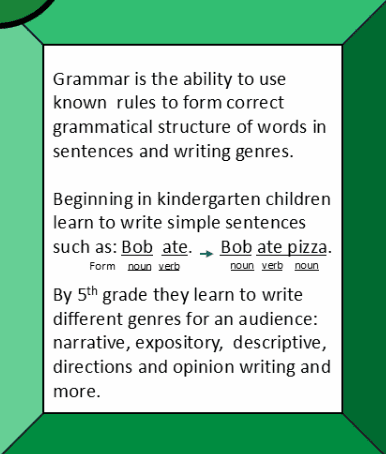
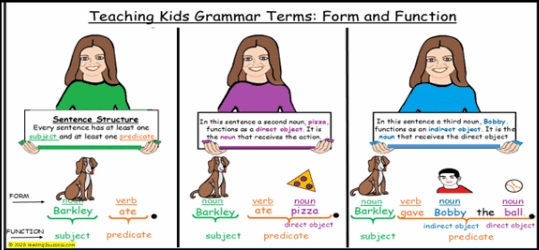
Grammar for kids teaches early readers to understand how sentences work. They begin by learning that simply sentence have two main parts: a noun that acts as the subject and a verb that acts as the predicate.
For example, in the sentence Barkley ate. Barkly is the subject and ate is the predicate. This structure helps children see who is doing the action and what action is happening.
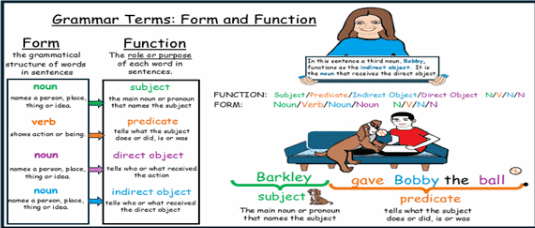
As children grow, they learn how sentences expand. Adding a direct object shows what the subject acted on. For example: Barkley ate pizza. In the sentence pizza is the direct object. Understanding form and function helps children see how words work together: form tells what the word is (noun, verb) while function tells what the word does in the sentence (subject, predicate, object).
Children can practice identifying direct objects by underlining them in simple sentences. For example: Sally delivers mail. and Marcus kicked the ball. In each sentence, the direct object shows what is being delivered or kicked. These short activities help children recognize how sentences grow and how meaning becomes clearer.
Punctuation is another important part of early grammar. A complete sentence begins with a capital letter and ends with a period, question mark or exclamation point. You can check understanding by asking children whether a sentence ends correctly. For example: Jenny loves horses. This sentence ends with a period because it is a statement. Teaching punctuation early helps children write clearly and understand how sentences communicate meaning.
When children learn how sentences are built-subjects, predicates, direct objects, and correct punctuation-they begin to understand the purpose behind reading and writing. These early grammar skills give kids the confidence to read with clarity, write with intention, and recognize how words work together to express ideas. With simple practice activities and clear examples, young readers quickly grow into strong, thoughtful writers.
When kids understand how sentence structures work and how to use the parts of speech, nouns, pronouns, verbs, adjectives and adverbs, they are building strong foundations in reading fluency and comprehension, the reason for reading.