Reading Skills/ K-5th Grade Students Reading Skills
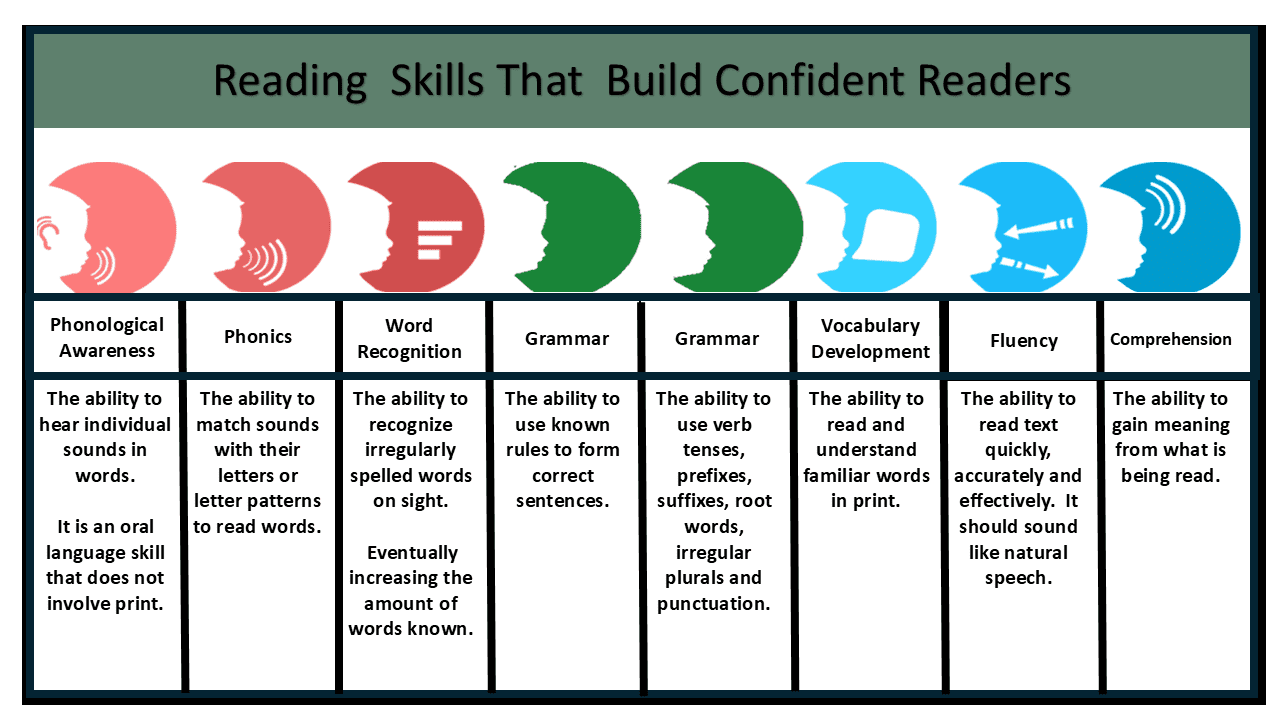
Reading Skills/K-5th Grade Gives parents a clear overview of the eight essential skills taught at Reading2success.com. These skills support children ages 4-12 in grades pre-K through fifth. Each skill has its own page with a teaching video and free downloadable templates, so families can practice at home with confidence
Why Reading Skills Matter Children enter school with different levels of early literacy experiences. Therefore, it is important that they receive skills that are purposeful to give each child a good start in reading.
Phonological Awareness Children begin their reading journeys with phonological awareness, the ability to hear and work with the individual sounds in spoken words. For example, it includes rhyming activities, reading pattern books, sorting pictures by beginning or ending sounds and using sound boxes. As a result, these activities build the foundation for all future reading skills.
Phonics, Once children can hear sounds, phonics teaches them how those sounds connect to letters. For example, the word cat, has three sounds -/c/,/a/,/t/ - that blend together to make the word. As students continue practicing, they begin reading simple words with increasing accuracy.
Word recognition Next, children learn to recognize new words automatically, including irregularly spelled words and high-frequency sight words. In addition, sight word instruction progresses from single words to short phrases and complete sentences. As a result, students read more smoothly and confidently.
Grammar Instruction develops in two parts. First. children learn how to use known rules to form correct sentences. Then. they expand their skills by studying verb tenses, prefixes, suffixes, root words, irregular plurals, and punctuation. Because of this, these tools help them write clearly and understand how sentences work. Click the link to see how I teach base words .https://www.youtube.com/watch?v=1ro0-ri2eP0
Vocabulary development As children read more, they grow their vocabulary. They learn synonyms (gift and present), antonyms (cold and Hot), and verbs with similar meanings (buy and purchase). Because vocabulary strongly influences comprehension, students practice using new words in sentences, conversations, and writing.
Reading Fluency develops as children move from slow, word-by-word reading to smoother, more accurate reading that sounds like natural speech. Through repeated reading, guided practice, and modeling, students build confidence and begin reading with appropriate pace and expression.
Reading comprehension Finally students learn to understand what they read. Kindergarten focuses on guided support while first grade introduces literal question. By mid-first grade, children begin answering inferential questions that require deeper thinking. As comprehension grows, students connect ideas, explain their reasoning and enjoy reading more fully.